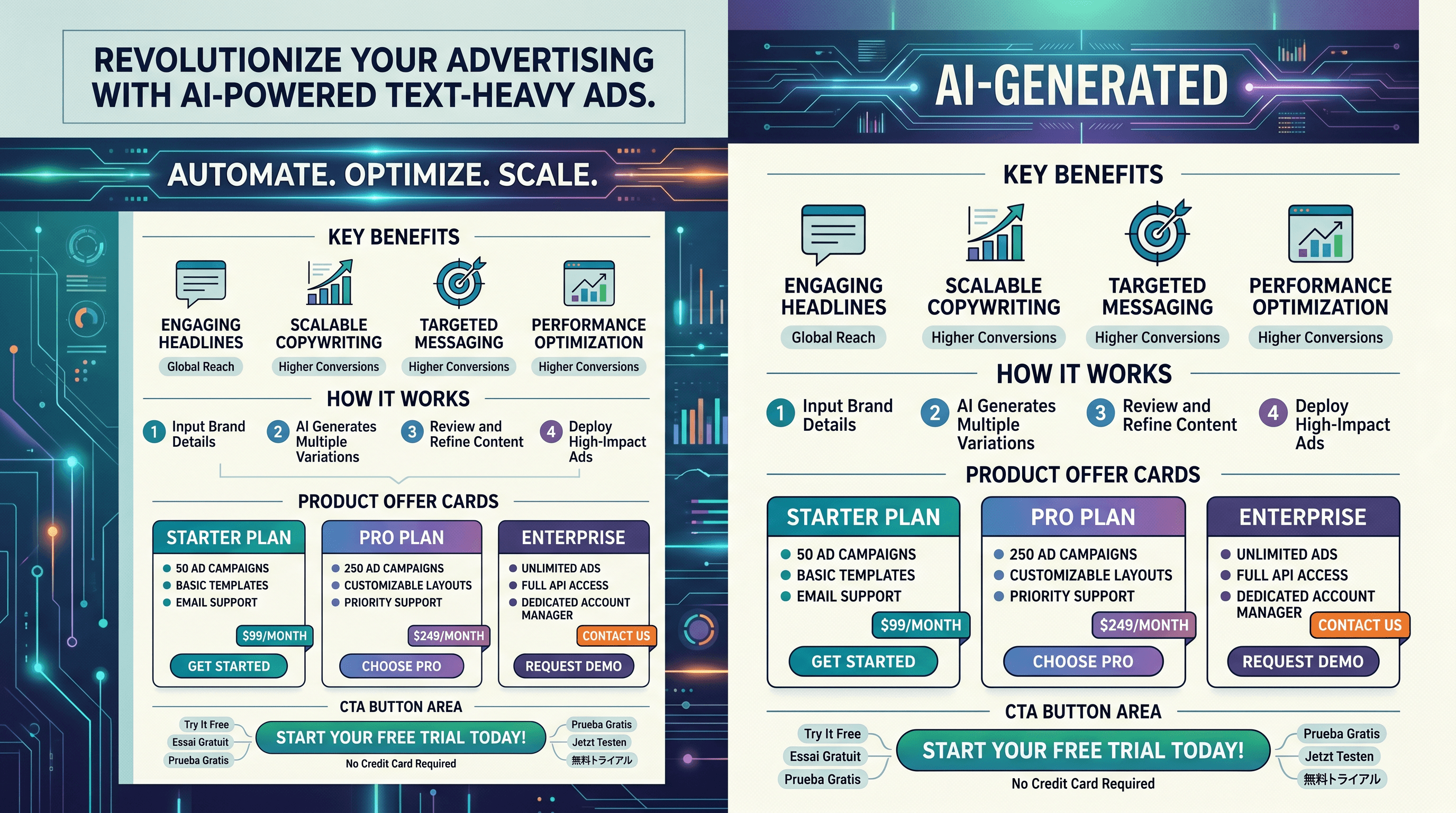
Why GPT Image 2 Is Strong for Text-Heavy Ads (and Where It Still Fails)
Why GPT Image 2 is useful for text-heavy ad layouts, plus the common weak points and practical fixes for cleaner outputs.
Text heavy advertising is a hard benchmark for any image model. It is not enough to generate an attractive background. The output must support clear message hierarchy, readable copy, and layout discipline across channels. GPT Image 2 is often selected for this use case because it can follow structured prompt direction and handle on image text more reliably than many earlier workflows. OpenAI’s own image generation guidance and prompting examples also place clear emphasis on instruction clarity, which is exactly what text heavy ad production demands.
That said, teams should avoid treating text performance as guaranteed. In practical production, failures still appear: awkward line breaks, uneven spacing, over crowded blocks, and occasional character level distortions in dense layouts. The right response is not to abandon the model. The right response is to run a process that separates composition and copy precision.
Why text heavy ads are different
A lifestyle image can tolerate small imperfections. A conversion ad usually cannot. If price text is unclear or call to action hierarchy is weak, performance drops. That means your generation workflow must optimize not just aesthetics, but communication clarity.
Text heavy assets require:
- Clear reading order
- High contrast typography zones
- Controlled spacing and margins
- Reliable emphasis on key message lines
- Consistency across variant sets
These requirements are operational, not artistic. They should be encoded directly in prompts and review checklists.
Prompt architecture for ad readability
A stable prompt layout for text heavy output is:
- Campaign context and audience
- Visual scene and composition
- Exact copy lines in quotes
- Reading order and emphasis rules
- Hard constraints on layout and exclusions
- Output channel and aspect ratio
This structure avoids the common failure where text requirements are buried under style language. Keep copy instructions short and explicit. If possible, include only the lines needed for that variant. Very long copy blocks increase risk of spacing issues.
Two phase generation strategy
One phase generation can work, but two phase generation is usually safer for performance critical ads.
Phase one: build composition and hierarchy with placeholder text zones. Phase two: refine exact copy, alignment, and legibility.
This split reduces the cognitive load in each run and gives reviewers a clearer approval path. It also helps teams diagnose whether issues come from layout logic or text rendering.
Common failure patterns and fixes
1. Copy looks cramped
Cause: too many lines competing for limited space. Fix: reduce copy density, increase whitespace requirement, and prioritize one primary message plus one secondary line.
2. Reading order is unclear
Cause: no explicit hierarchy instruction. Fix: define order directly, for example headline first, offer line second, CTA third.
3. Visual style overpowers text
Cause: style instructions are stronger than communication constraints. Fix: move typography and contrast constraints earlier in prompt priority.
4. Variants drift too far
Cause: each run changes multiple variables. Fix: hold composition fixed and rotate only one message or palette variable per variant batch.
Review model for marketing teams
Use a fast three gate review:
- Legibility gate: can users read key copy instantly at target size?
- Message gate: is the intended offer and CTA clear in one glance?
- Brand gate: does this match color and tone constraints?
If any gate fails, request one focused revision only. Avoid broad “make it better” feedback, which often causes drift.
Where GPT Image 2 can still struggle
Even with good prompts, edge cases remain. Very dense multilingual layouts, extreme typography stylization, and tiny legal copy blocks can still require manual polish. Treat this as a normal production step, not a model defect. In many teams, the generated output acts as a high quality draft that goes through a lightweight final edit pass.
How to scale this workflow
Build reusable prompt templates by campaign type:
- Flash sale card
- Product launch tile
- Social announcement banner
- Retargeting promo unit
Each template should include approved copy structure and fixed constraints. Over time, your team spends less effort inventing prompts and more effort testing message performance.
Bottom line
GPT Image 2 is strong for text heavy advertising when teams combine structured prompts, two phase generation, and strict review gates. The model can accelerate production significantly, but quality depends on process discipline. If your team treats legibility and hierarchy as first class constraints, you can generate usable ad variants faster while keeping communication quality high.
Campaign testing workflow
For performance teams, creative quality is only part of the story. Pair each generated variant with a clear hypothesis, such as stronger urgency language or simplified visual hierarchy. Then test variants in controlled audience groups and compare click through and conversion signals. This closes the loop between generation and measurable business outcome.
Documentation habit that saves time
Keep a lightweight internal log for each campaign template: prompt version, accepted output examples, rejected failure patterns, and final correction notes. Over time, this creates a reusable playbook that improves prompt quality and reduces repeated mistakes across teams.
More Posts

GPT Image 2 Prompt Framework: A Simple Format That Cuts Retry Cost
Use a clear GPT Image 2 prompt structure to reduce retries, improve output consistency, and speed up production review.

Should You Subscribe Now? A Practical GPT Image 2 Evaluation Checklist
Use this short checklist to decide whether GPT Image 2 is the right paid workflow tool for your current production needs.
GPT Image 2 vs Midjourney V8.1: Which One Fits Real Production Work?
A practical comparison of GPT Image 2 and Midjourney V8.1 based on production workflow needs, not style preference alone.