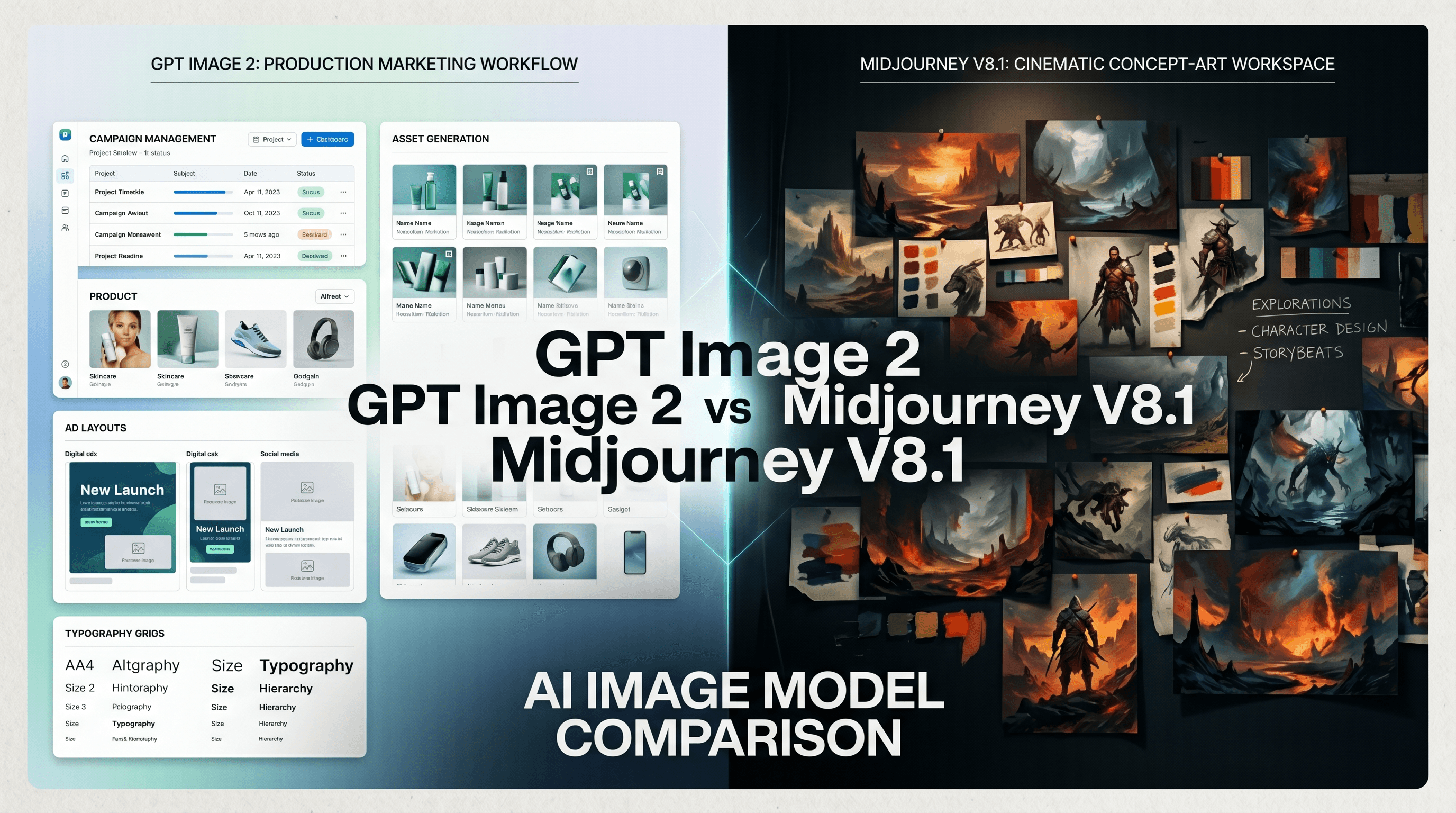
GPT Image 2 vs Midjourney V8.1: Which One Fits Real Production Work?
A practical comparison of GPT Image 2 and Midjourney V8.1 based on production workflow needs, not style preference alone.
Comparing GPT Image 2 and Midjourney V8.1 is only useful if you compare them against your real production constraints. If you evaluate with one beautiful prompt and no deadlines, both can look excellent. In daily work, the difference usually appears in text handling, controllability, iteration behavior, and integration path.
OpenAI positions GPT Image 2 as a high quality generation and editing model with strong prompt driven workflows, and the official image generation documentation emphasizes iterative editing and structured prompting. Midjourney V8.1, based on its official version documentation and community usage patterns, is often praised for strong aesthetic exploration and stylized concept quality. Both can produce impressive visuals, but they solve different parts of a pipeline.
Start with workflow criteria, not taste
Before comparing outputs, define the production questions:
- Does the model handle on image text reliably enough for ads and UI style layouts?
- Can your team steer revisions predictably over multiple turns?
- How quickly can reviewers get from prompt to publishable asset?
- How often do outputs drift from brand constraints?
- How easy is it to operationalize the model in your existing stack?
Without these criteria, comparisons collapse into subjective preference.
Where GPT Image 2 often leads
GPT Image 2 tends to be strong when your tasks require readable image text, structured prompt control, and repeated revision loops. For marketing creatives, product cards, social variants, and simple UI visuals, this matters a lot. If your approval process includes checking labels, headlines, and hierarchy, text reliability can outweigh purely artistic style.
Integration is another practical factor. Teams already building around OpenAI APIs may find adoption faster because GPT Image 2 sits in a familiar tooling environment. That does not automatically make output better, but it can reduce implementation friction and speed up experimentation.
Where Midjourney V8.1 often leads
Midjourney V8.1 is commonly favored for high style direction and mood driven concept work. If your early stage requirement is to explore many artistic directions and find one strong visual language, Midjourney can be very effective. Creative teams often use it to spark campaign direction before moving to production constrained outputs.
In those settings, the goal is not strict text precision or API first workflow. The goal is aesthetic range and visual character. That is a different optimization target from conversion focused ad operations.
The biggest mistake in model comparison
The most common mistake is trying to pick one universal winner. In practice, most teams have mixed task types. Some tasks need structured reproducibility and text discipline. Others need exploratory art direction. One model can be primary, but a two model strategy is frequently more efficient than forcing a single tool into every scenario.
If you must choose one, choose based on your highest volume task, not your most exciting demo task.
A practical test protocol
Use a shared prompt pack across both models:
- Five text sensitive assets (ad cards, promo posters, product labels).
- Three iterative edit tasks (same asset, three revision rounds).
- Two style exploration tasks.
Evaluate with the same review rubric: publishability, revision effort, and total time to approval. This reduces bias and keeps the decision tied to delivery outcomes.
Interpreting the results
If GPT Image 2 yields higher acceptance for text intensive assets and faster revision stability, it is likely the better production default for conversion workflows. If Midjourney consistently produces stronger concept visuals with fewer direction resets in early ideation, it may be the better lead tool for brand exploration.
If results are split, that is not failure. It is signal. Use each model where it performs best, and define handoff points between them.
Team operating model that works
A common structure is:
- Concept phase: broader style exploration.
- Production phase: structured generation with strict constraints.
- Finalization phase: manual polish and QA.
This keeps creative freedom early and operational reliability later. It also aligns tool choice with stage objectives.
Cost and throughput perspective
Do not evaluate cost by prompt count alone. Evaluate cost per approved asset. A model that seems cheaper per run can become expensive if revision burden is high. Likewise, a model with higher per run cost can still be efficient if approval happens faster and cleanup effort is lower.
Bottom line
GPT Image 2 and Midjourney V8.1 are both useful, but they are optimized for different kinds of work. GPT Image 2 is often a stronger fit for text heavy, iteration driven production pipelines. Midjourney V8.1 is often stronger for aesthetic exploration and creative direction. The right decision is not ideological. It is operational: test both with your own tasks, measure approved output rate, and assign each model to the stage where it creates the most value.
QA checklist before shipping
Before final handoff, run a short quality check across both candidate outputs:
- Is message hierarchy clear at real display size?
- Are product details readable without zooming?
- Does the variant remain on brand across color and tone?
- Is there any artifact or typo that blocks publication?
This step prevents teams from choosing a model winner based on full screen preview alone. Many issues only appear when assets are rendered in real placements.
Implementation note for mixed stacks
If your workflow uses both models, define explicit handoff rules in your production documentation. Example: concept exploration outputs are accepted only as direction references, while publishable assets must pass structured QA in the production generation stage. This keeps creative exploration flexible while protecting downstream quality standards.
More Posts
How E-commerce Teams Use GPT Image 2 for Faster Product Creative Cycles
How e-commerce teams apply GPT Image 2 to product creatives, campaign variants, and faster test cycles with fewer bottlenecks.

Common GPT Image 2 Failure Modes and Fast Workarounds for Teams
A practical look at the most common GPT Image 2 failure modes and the fastest ways to recover without slowing production.

Should You Subscribe Now? A Practical GPT Image 2 Evaluation Checklist
Use this short checklist to decide whether GPT Image 2 is the right paid workflow tool for your current production needs.