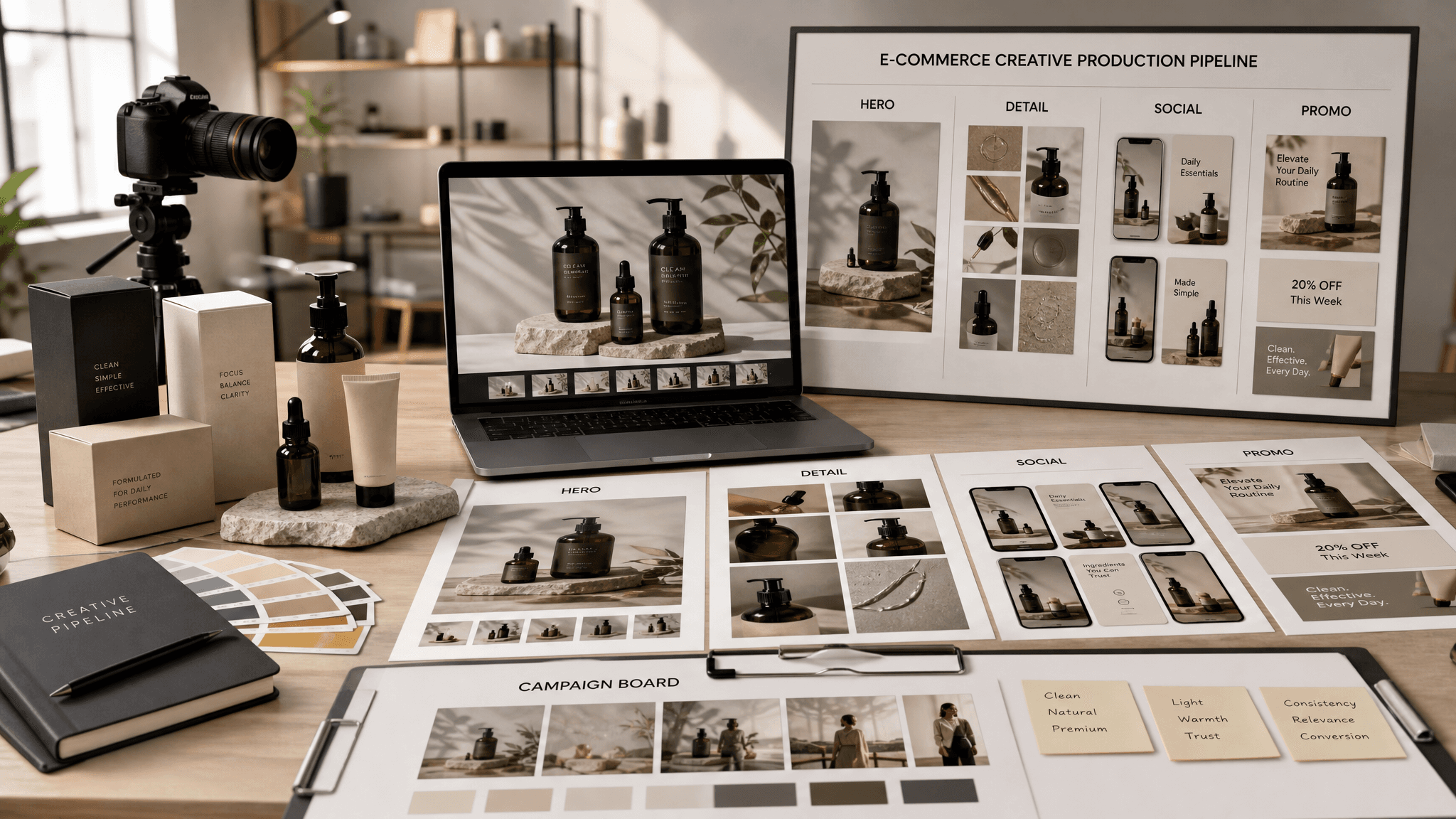
How E-commerce Teams Use GPT Image 2 for Faster Product Creative Cycles
How e-commerce teams apply GPT Image 2 to product creatives, campaign variants, and faster test cycles with fewer bottlenecks.
E-commerce creative operations are repetitive by nature: product hero images, seasonal campaign swaps, feed variants, promo cards, and channel specific crops. The bottleneck is rarely “no idea.” The bottleneck is producing enough usable assets fast enough while keeping brand consistency and review quality. GPT Image 2 can help with this problem when used as a workflow accelerator rather than a one click art tool.
OpenAI’s image generation guidance emphasizes iterative generation and editing, which maps well to e-commerce requirements. Teams often need a first draft quickly, then several controlled revisions to match merchandising goals, copy hierarchy, and storefront layout constraints. A model that supports prompt based iteration with clear structure is valuable in this setting.
Where e-commerce teams see practical gains
The biggest gains appear in repetitive asset classes:
- Product hero draft variations
- Seasonal visual refreshes
- Paid social variant sets
- Marketplace and channel format adaptations
- Collection banner concepts
In these tasks, speed and consistency matter more than one perfect artistic output. If teams can generate multiple viable directions in one session and review them with clear acceptance rules, campaign cycles shorten.
Workflow pattern: batch by product family
A common mistake is mixing unrelated products in one generation run. Better results come from batching by product family and visual intent. For example, run skincare items in one batch with consistent palette and lighting assumptions, then run accessories in a separate batch with different framing logic.
This reduces context confusion and makes outputs easier to compare. Reviewers can focus on composition and message fit instead of disentangling mixed product contexts.
Two pass method for text overlays
For e-commerce promotions, on image text is usually required: discount tags, short headlines, urgency lines, and category labels. A reliable pattern is two pass generation.
Pass one: lock product composition and visual hierarchy. Pass two: refine exact text placement, spacing, and prominence.
Trying to solve composition and dense copy in a single pass can work, but failure rates are often higher. Two pass workflows create cleaner quality control and lower revision stress.
Prompt structure for merchandising teams
Use modular prompts with explicit blocks:
- Scene and background setup.
- Product identity and material cues.
- Brand style direction.
- Required copy and reading order.
- Hard constraints such as aspect ratio and safe margins.
- Final use case, for example PDP hero or mobile ad card.
This mirrors current best practice from OpenAI prompt guidance and improves cross team collaboration. Designers can edit style blocks, marketers can edit copy blocks, and operators can enforce technical constraints.
Review checklist that protects throughput
To prevent endless back and forth, define a simple review gate:
- Is the product clearly visible and correctly represented?
- Is copy readable at target display size?
- Does the image follow brand color and tone rules?
- Are there obvious artifacts or visual noise?
- Is the asset ready now or does it need one focused revision?
This binary style triage helps teams avoid “maybe acceptable” loops that consume hours.
Handling failure without losing pace
Even with good prompts, failures happen. Refusals, drift, or noise are part of production reality. The key is to avoid random retries. Use a short recovery rule:
- If copy is wrong, edit copy block only.
- If composition is wrong, edit scene and constraints.
- If quality degrades after many turns, start a clean run with approved constraints.
This isolates variables and keeps the pipeline predictable.
Metrics that matter to e-commerce
Track metrics that map to business output:
- Time from brief to first acceptable draft
- Number of revisions per approved asset
- Acceptance rate by asset type
- Cost per approved creative
These numbers show whether GPT Image 2 is reducing operational friction or simply moving effort into cleanup.
Integration and handoff
E-commerce teams rarely publish raw generated files without checks. The stronger workflow is generation plus light design polish plus QA. GPT Image 2 handles speed and early variant breadth. Internal design tools handle final alignment and packaging. This hybrid model is usually more robust than expecting one tool to perform every step perfectly.
Bottom line
For e-commerce, GPT Image 2 is most valuable when it increases creative throughput while keeping quality review manageable. Teams that use batch discipline, two pass text workflows, and structured prompts generally get faster campaign iteration and more publishable assets per week. The win is not only better images. The win is a smoother path from product brief to approved creative at scale.
Governance and brand safety
As teams scale generation volume, governance becomes as important as prompt quality. Keep a shared asset approval policy that defines what can ship automatically and what requires human review. For regulated categories or sensitive claims, require manual signoff before publication. This protects brand trust and reduces the risk of pushing visually correct but policy risky assets into paid channels.
Practical rollout plan
Start with one product vertical and one campaign type for two weeks. Measure acceptance rate and revision time, then expand only when the workflow is stable. This staged rollout helps teams learn quickly without disrupting the entire creative pipeline.
More Posts

Should You Subscribe Now? A Practical GPT Image 2 Evaluation Checklist
Use this short checklist to decide whether GPT Image 2 is the right paid workflow tool for your current production needs.
GPT Image 2 vs Midjourney V8.1: Which One Fits Real Production Work?
A practical comparison of GPT Image 2 and Midjourney V8.1 based on production workflow needs, not style preference alone.

GPT Image 2 Prompt Framework: A Simple Format That Cuts Retry Cost
Use a clear GPT Image 2 prompt structure to reduce retries, improve output consistency, and speed up production review.